
Cartoning Machine & Cartoning Line
The cartoner is the standard part. What feeds it isn’t. Tell us what you’re packing and send us the carton — we’ll tell you what the front end has to be, how long the line runs, and where the money actually goes.
Bottles · Blisters
Tubes · Sachets
Sticks · Small food packs
Tuck-in
Snap-bottom
Hot-melt glue
Servo-driven
or mechanical
Infeed → cartoning
→ coding → checkweighing
→ case packing
You won’t find a single cartoning speed on this page. Speed is set by three things: your carton closure, your product format and your feeder. We don’t know any of the three yet. Send us the carton and the product and we’ll give you the figure for your line, not the figure from a brochure.
U.S. line: +1 (213) 526-8644 — calls and WhatsApp, Live 8:00–11:00 AM ET, Monday to Friday. Our engineers, not a distributor.





Three things we'll do before you've paid us anything
You can’t audit a factory from six thousand miles away. So start by giving us something to be wrong about.
None of that is a quote and none of it costs anything. If what comes back is useful, you’ll know more about how we work than a reference list would have told you.
01
Send us your carton and your product
We'll tell you whether they'll run on an automatic cartoner as they are — and if they won't, exactly what has to change.
02
Send us your floor dimensions
Length, width, height, and where the doors and columns are. We'll lay out the line and check the space fits it.
03
Send us your SKU list
We'll tell you which of your products can share one machine and which of them can't, before you find out the hard way.
What you're packing decides what goes in front of the cartoner
Every cartoner on the market erects a carton, pushes something into it and closes it. The machines are more alike than suppliers let on. What differs — in price, in floor length, in how much can go wrong — is the front end.
Product format → Infeed method → Collating equipment → Line length and price
Bottles
Off the labeller, down a conveyor, singulated and timed, then a separate upender turns each bottle onto its side — either by screw feed or by a straight drop into the carton. Supplement bottles, syrup and oral-liquid bottles, small cosmetic jars and small food jars are all the same handling problem.
Per carton:
Usually one
Collating needed:
Singulation, timing and an upender
Send us:
Bottle drawing or a sample, cap included
Blisters
They arrive one at a time along a conveyor and drop into a magazine. The machine counts them into groups — three to a carton means three drop, one carton runs, three more drop. The count is what drives the whole front end here, not the blister itself.
Per carton:
Several, stacked
Collating needed:
Drop magazine and group counting
Send us:
Blister dimensions and pieces per carton
Tubes
Straight off the tube filling and sealing machine, oriented, then dropped one at a time into the magazine. Creams and ointments in laminate, aluminium or plastic tubes all run, but the material changes how the tube behaves on the way in.
Per carton:
Usually one
Collating needed:
Orientation and drop feed
Send us:
Diameter, length and tube material
Sachets — four-side seal
They arrive one at a time along a conveyor and drop into a magazine. The machine counts them into groups — three to a carton means three drop, one carton runs, three more drop. The count is what drives the whole front end here, not the blister itself.
Per carton:
Two or three
Collating needed:
Upending plus a grouping station
Send us:
Sachet size and count per carton
Stick packs
They come off the stick machine unordered. Before anything can be pushed into a carton they have to be brought into order, and that ordering system is the most demanding front end we build. If you’re cartoning sticks, this is the conversation to have first — not last.
Per carton:
Several
Collating needed:
Unordered → ordered → grouped
Send us:
Stick dimensions and count per carton, early
Small food packs
A large single pouch goes one to a carton and is the easiest case on this list. Small snack, seasoning and confectionery packs group the same way sachets do, and inherit the same difficulty.
Per carton:
One, or grouped
Collating needed:
Upending; grouping if more than one
Send us:
Pack size and count per carton
Buyers usually assume the machine is the big line item on the quote. On stick packs and grouped sachets it often isn’t. When two quotes for “a cartoning machine” come back far apart, the difference is almost never in the cartoner.
Don’t compare cartoners. Compare what feeds them.
When hand-loading is the right answer
Automatic collating is fast, but every product format and every carton size needs its own change parts and its own setup. If you run a lot of SKUs in short runs, that setup cost lands on you every single week.
Plenty of our U.S. customers load the cartoner by hand for exactly that reason. Operators stand at the infeed and place product into the buckets. Need more output? You lengthen the loading section and put more people on it.
Labour is expensive in the U.S. and we know it. We’re telling you this anyway, because on a high-mix line it is often the cheaper answer — and because you’d find out in month three if we didn’t.
Tuck-in, snap-bottom or glue — settle this before you order, not after.
The closure is the one thing on a cartoner that is genuinely hard to change once the machine is built. Almost everything else is change parts.

Flaps fold and tuck into the carton. The most common closure in supplements and the simplest machine to build and run.
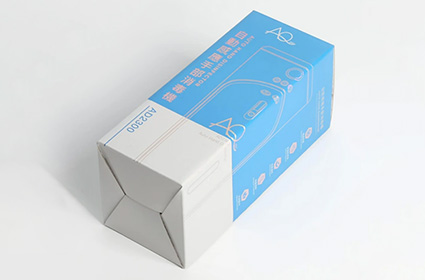
The base locks itself as the carton is erected. Used where the carton has to carry weight, or where the base needs to look finished.

Glued flaps — sealed and tamper-evident by design. On our servo-driven machine glue is an option you select, not a fixed build.
- Tuck-in ↔ snap-bottom: yes. The main frame is compatible. Switching between the two changes only a small number of local parts.
- Tuck-in ↔ glue: not realistically. The mechanics are far apart and this is not a modular quick-change. Switching is slow enough that we'd advise against planning a line around it.
- After the machine is built: changing closure type means rebuilding the core of it. Cost and lead time land close to a new machine.
So the first question isn’t which cartoner. It’s which carton. Send us the artwork or a flat sample and we’ll tell you what the machine has to be.
Will the carton you use now run on an automatic cartoner?
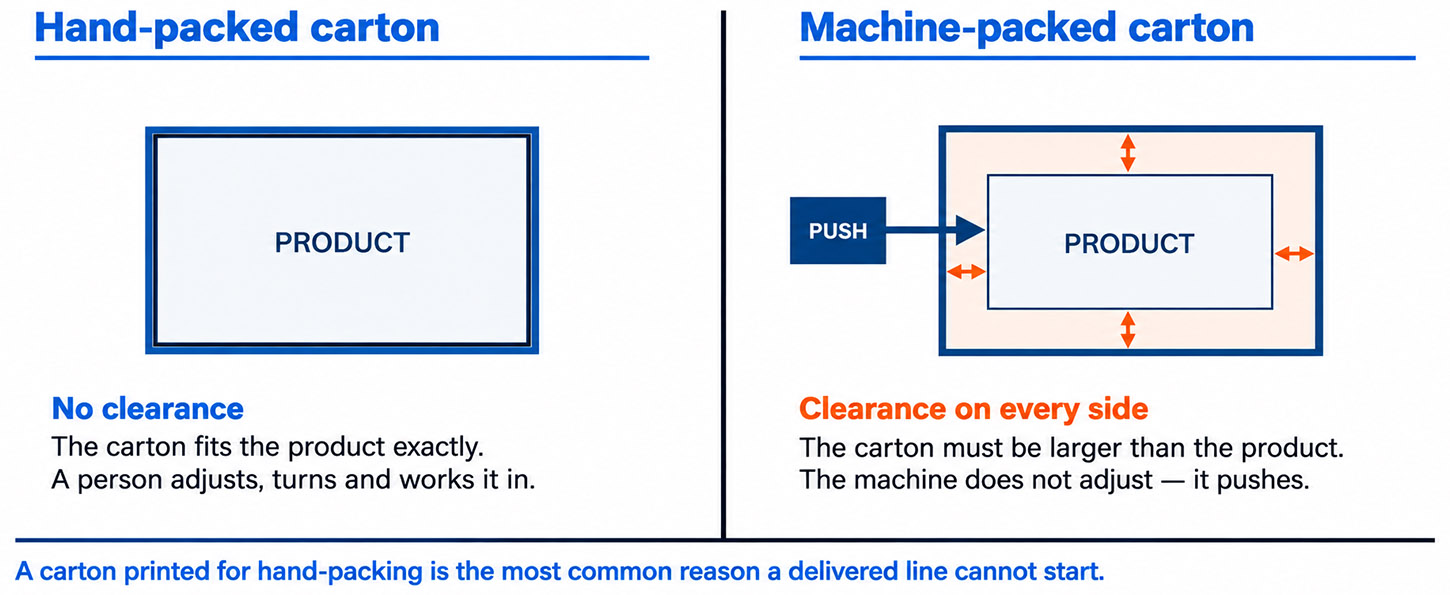
Often not as it stands. Hand-packing and machine-packing want different cartons, and this is the most common reason a line that has already landed can’t start.
A person can work a product into a carton that fits it exactly. A machine can’t — it pushes. The carton has to be larger than the product by a working clearance, and it has to hold that dimension consistently across the whole print run, not just on the sample you approved.
| What we check | Requirement | Why it matters |
|---|---|---|
| Dimensional tolerance | ±0.5 to ±1.0 mm at up to 60 cartons/min; ±0.3 to ±0.5 mm at 80 cartons/min and above. Measured on the finished carton blank | Outside it, cartons jam instead of filling |
| Board weight | 250 – 350 g/m² | Too light and the carton won't hold its shape as it's pushed |
| Score lines and flaps | Crease position within ±0.15 mm. Crease depth about two thirds of board thickness. Pre-creased cartons strongly preferred. Flap angle 90°, ±2–3° acceptable | Decides whether the carton opens square every time |
| Clearance to product | Carton must be larger than the product | Machines push; they don't place |
Send dimensions for the carton and for the product. Both. One without the other tells us nothing we can act on.
Send it anyway. This is more negotiable than most suppliers will admit — there is usually something to work with.
Then send us the product. We’ll size the carton around it. That’s the right order to do this in, and by far the cheapest place to solve it.
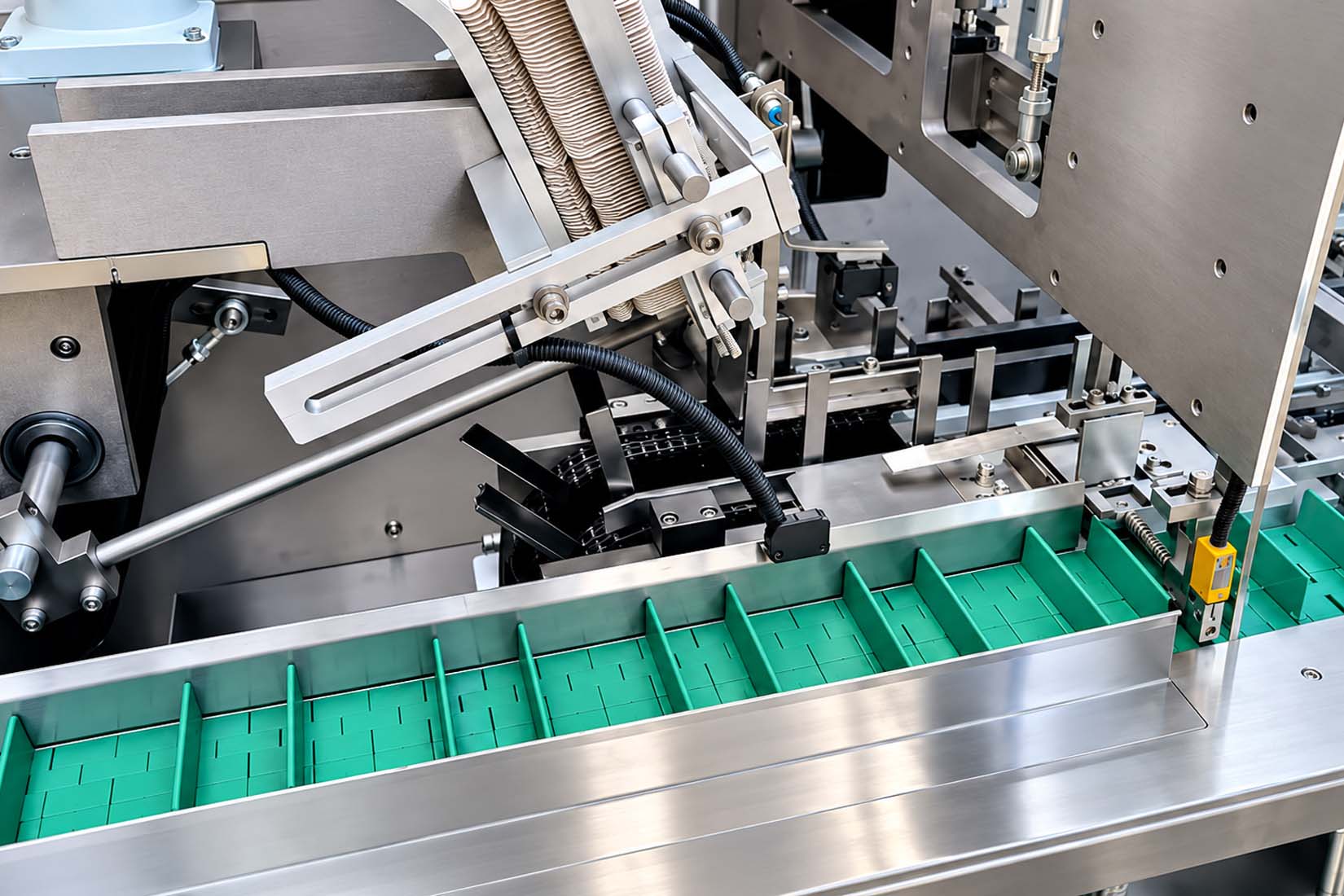
The cartoner is one machine in a section. We build the section
Almost nobody buys a cartoner on its own. Upstream, something has to feed it. Downstream, the carton has to be coded, checked and packed into a case. You can buy those from four suppliers, or from one.
Infeed & collating
The part that changes with your product
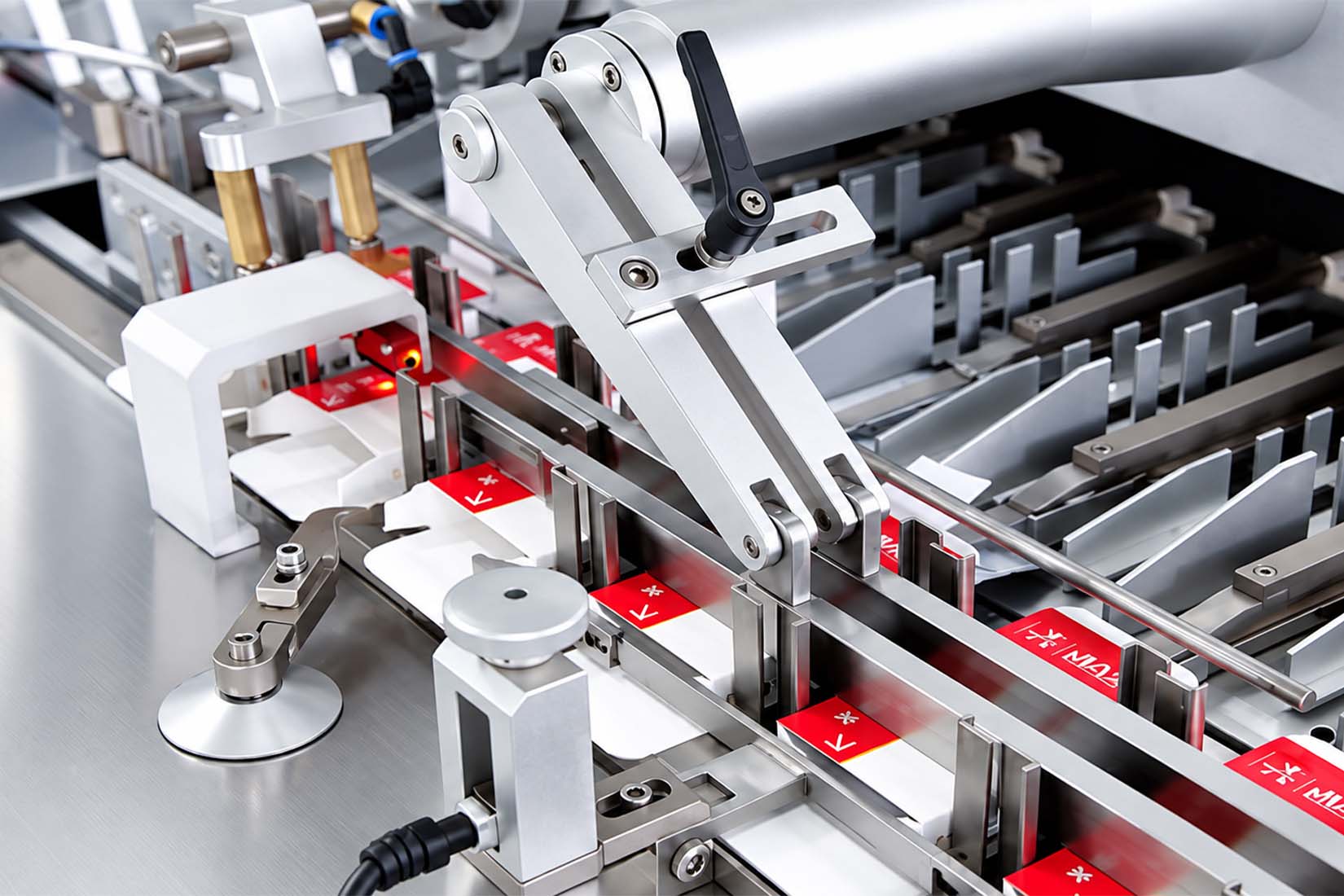
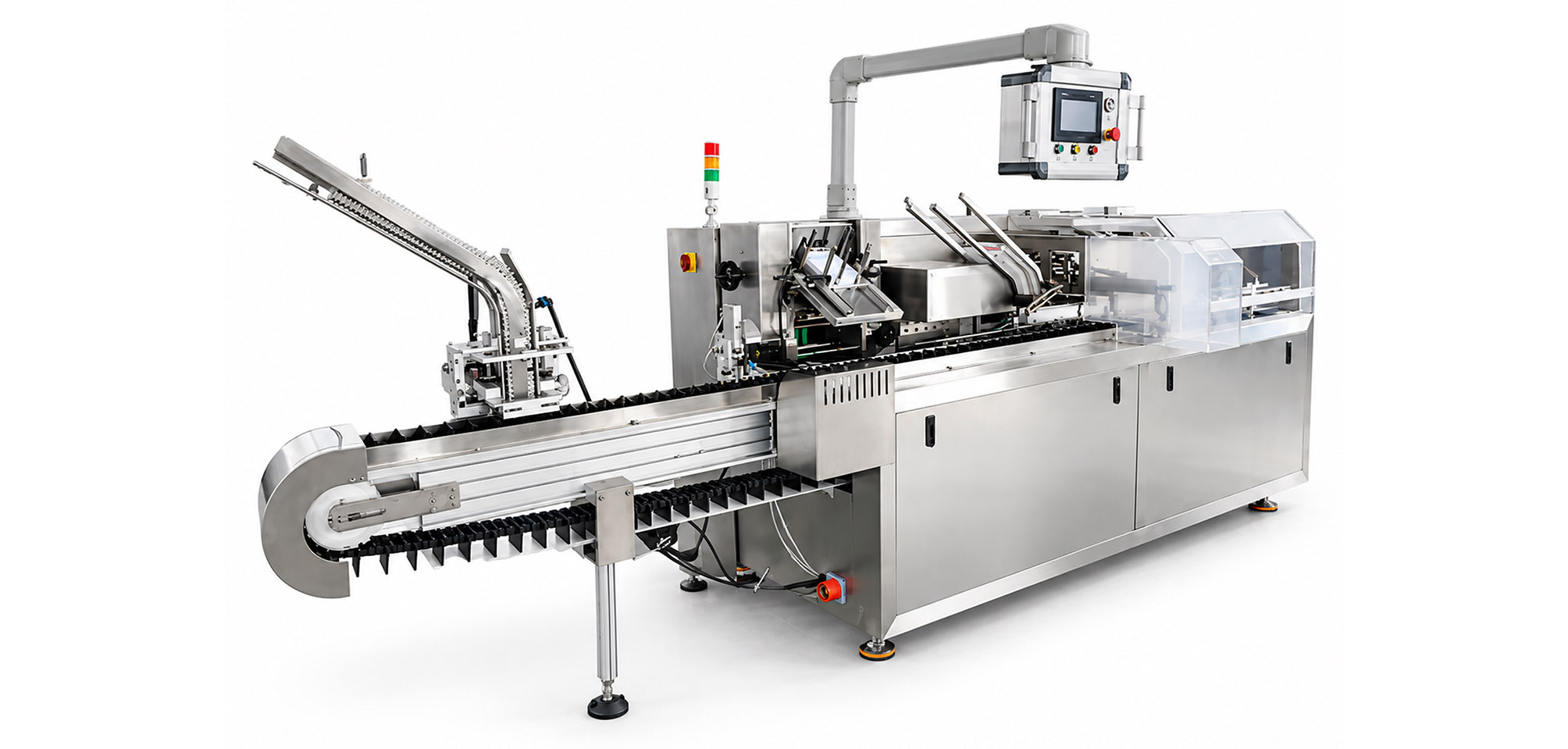
Cartoning
Erect, insert, leaflet, close, reject
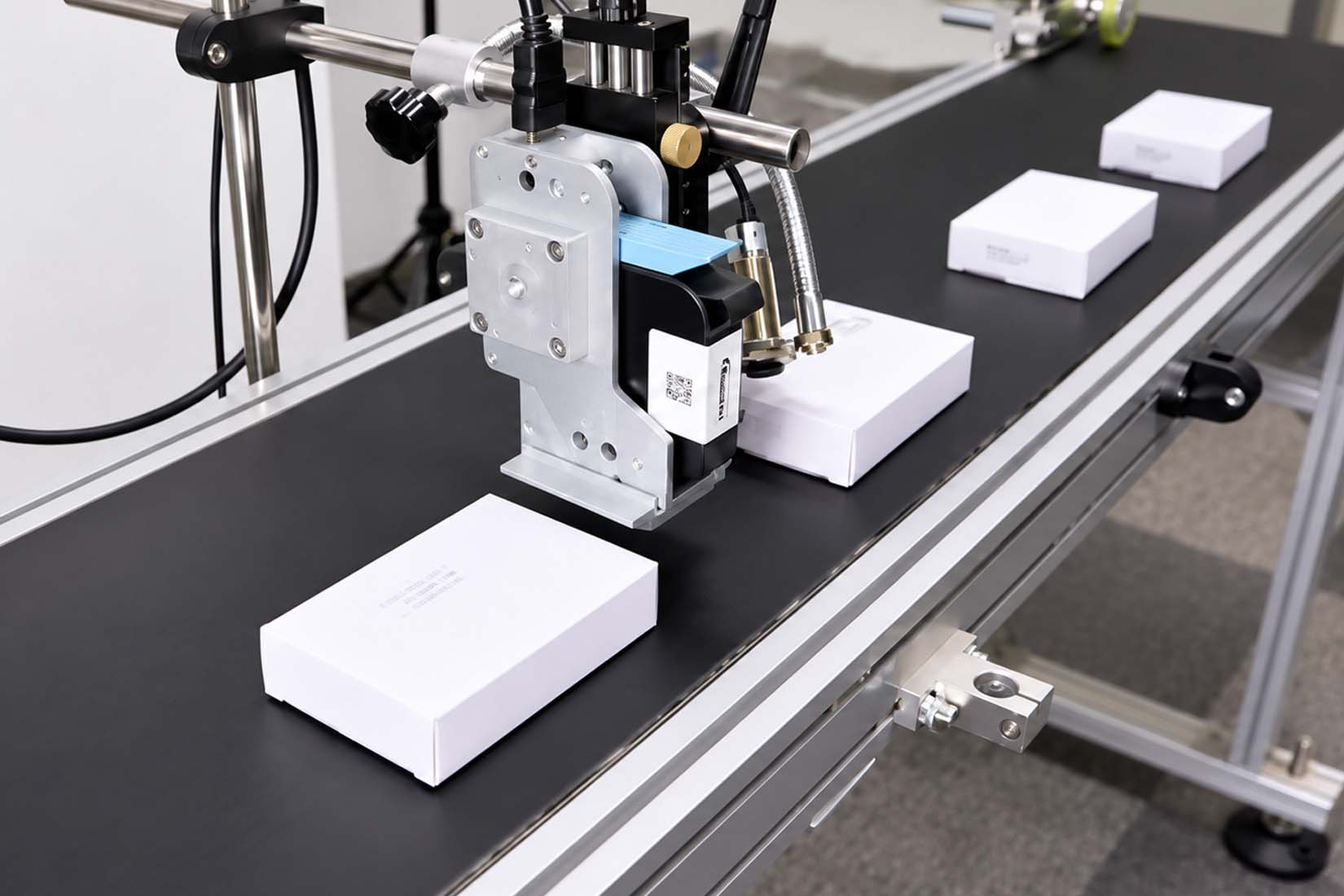
Coding
Lot and expiry onto the carton
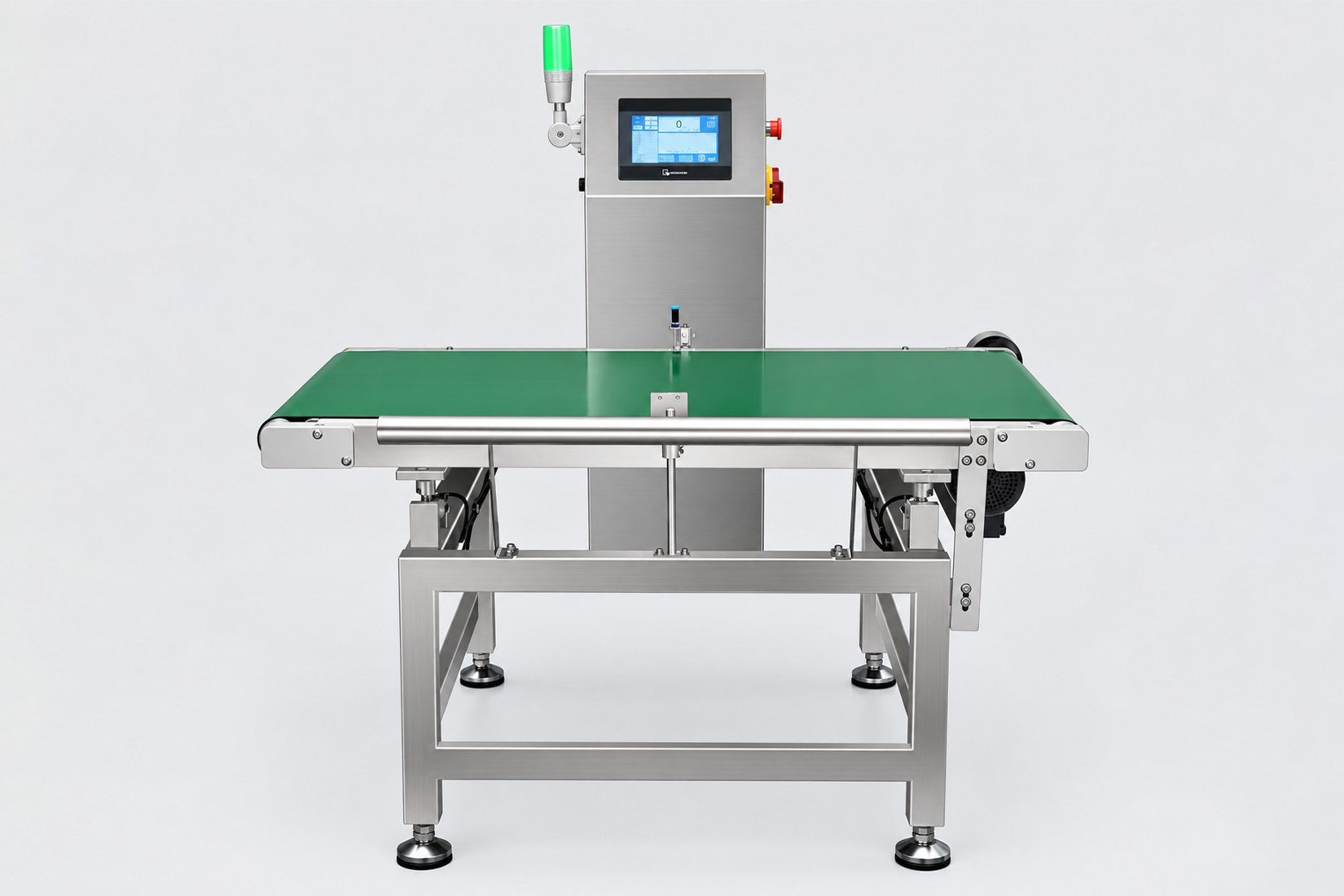
Checkweighing / X-ray
Catches a light carton, and what shouldn’t be inside
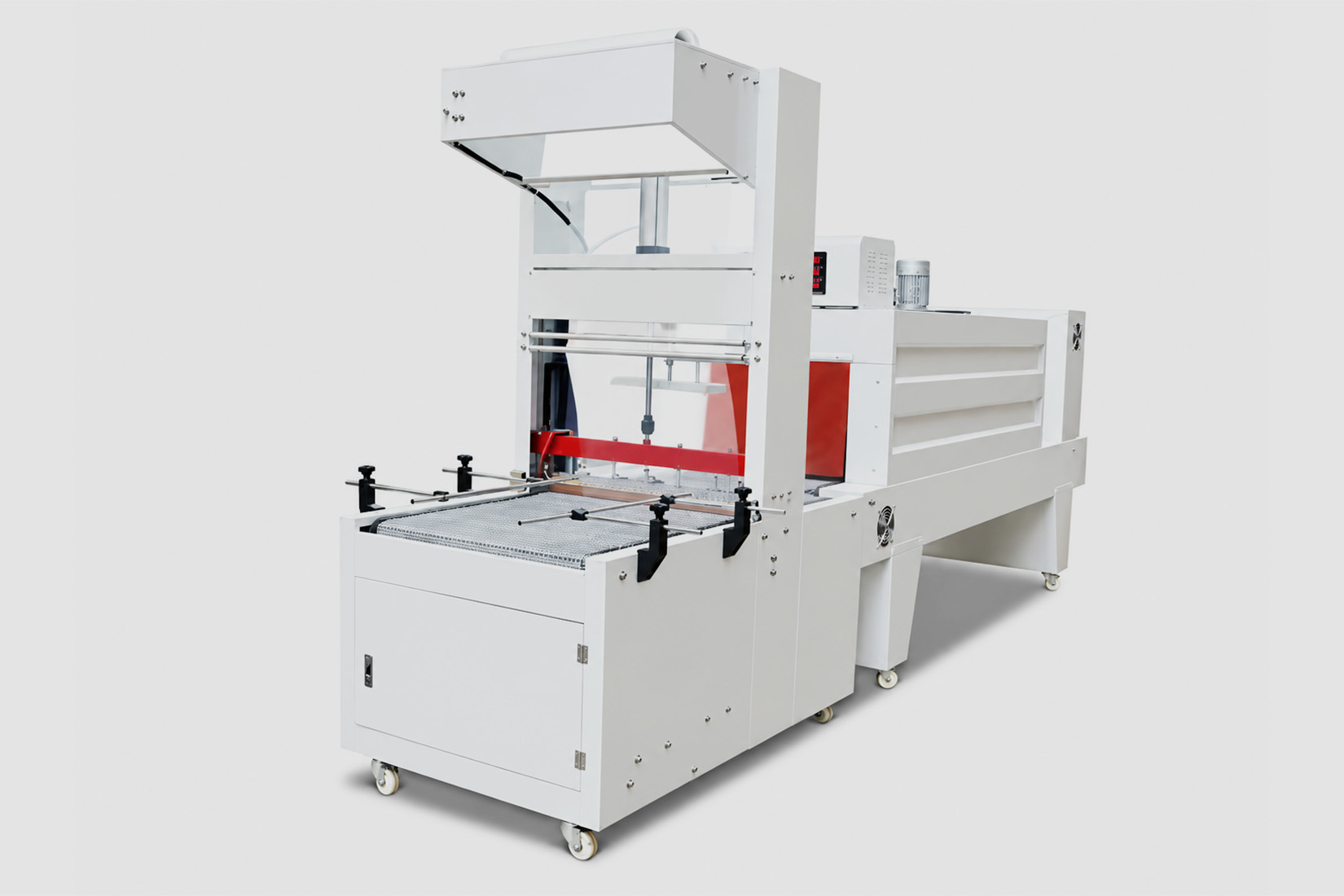
Overwrapping
Film around the finished carton
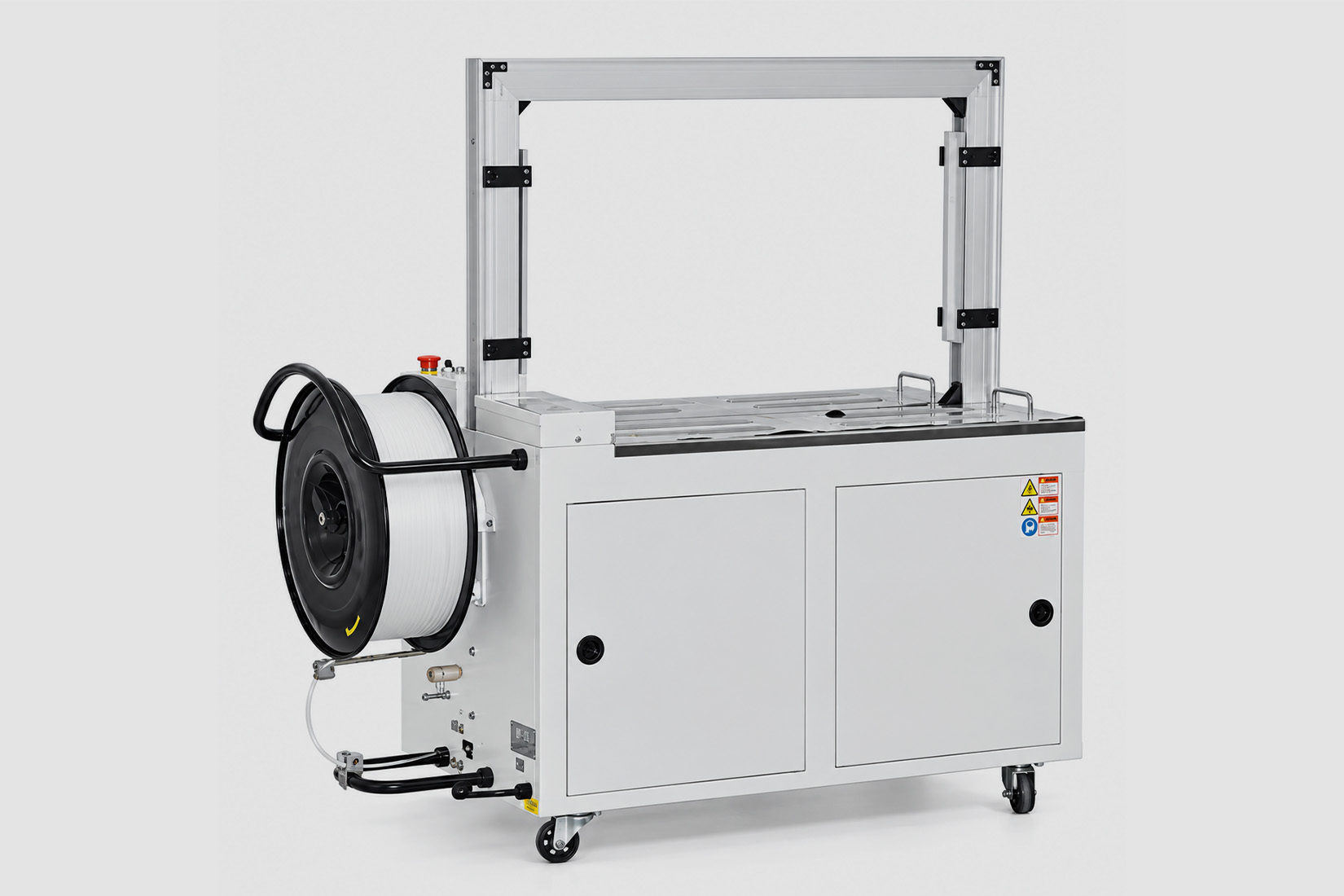
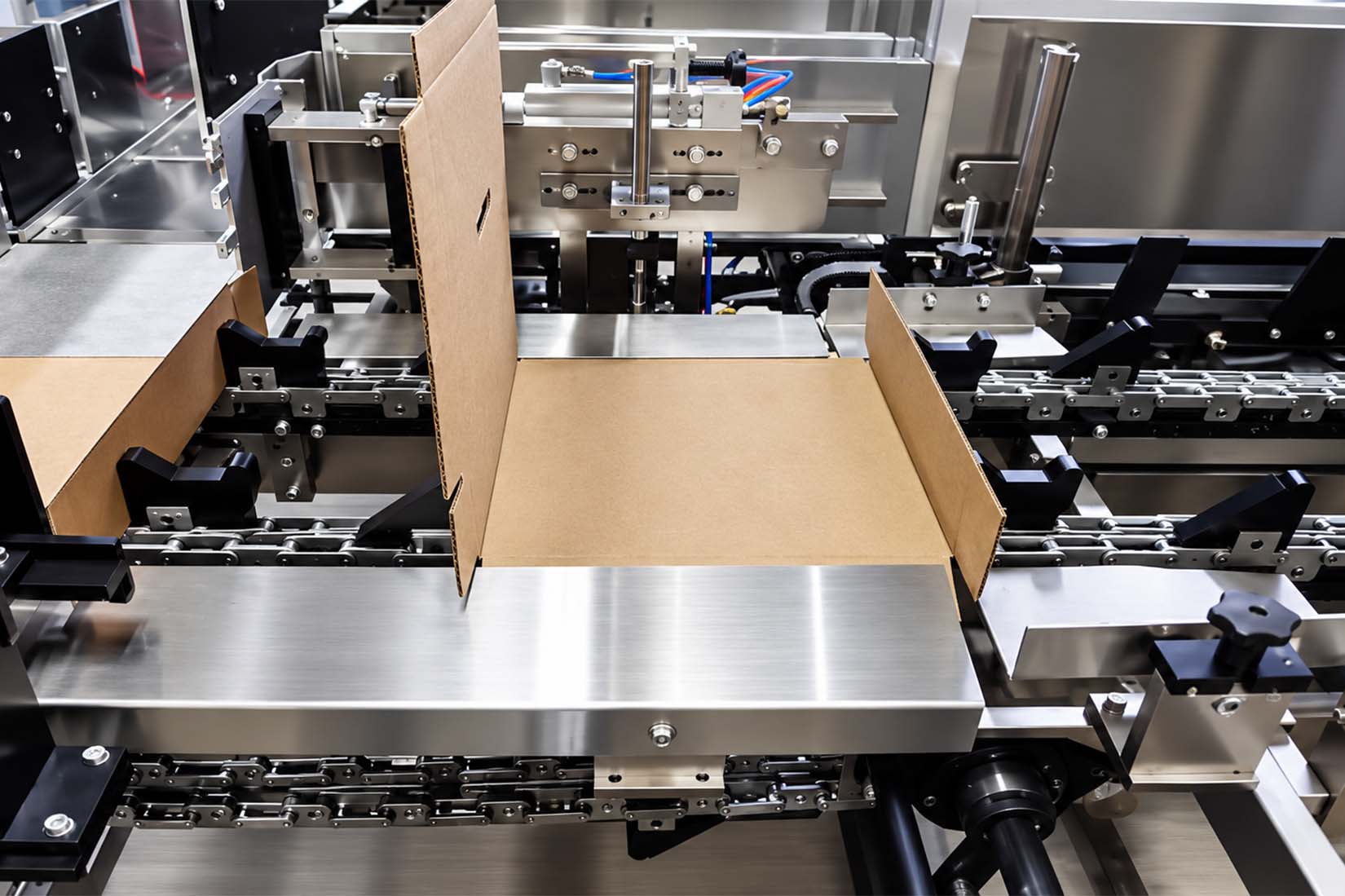
Bundling
Multipacks
Case packing
Cartons into the shipper
You can buy just the cartoner. Plenty of customers do and it’s a reasonable decision — budget and floor space are real.
What you’re actually choosing is who owns the handoffs. When a carton jams between two machines from two suppliers, each of them will tell you it’s the other one’s machine. When the whole section is ours, there’s nobody for us to point at.
Two drives. Not old and new — two different buyers
We build both and we sell both. Which one is right for you has very little to do with which one is newer.
| Servo-driven | Mechanical (cam-driven) | |
|---|---|---|
| Drive | Multiple servos on electronic cams | Cams, chains and an intermittent mechanism on a variable-frequency drive |
| Changeover | Stores recipes — sizes are recalled rather than re-set by hand | Hand wheels for length and width; change parts when carton height changes |
| Diagnostics | The servo system localises a fault; a remote module is available | Diagnosis leans on the experience of whoever is standing there |
| Controls | Our standard build, or a full Siemens build if your maintenance team standardises on it | |
| Best for | Many SKUs, short runs, frequent changeover | Larger batches and a settled range of cartons |
Model-by-model figures — speed, footprint, weight and carton size range — sit on the individual machine pages, confirmed per model and per configuration. Ask us for the spec sheet for the build you’re considering and we’ll send the confirmed one.
How to work out the speed you need — and why there isn't one on this page
Rated cartoning speed is the most quoted and least useful number in this category. Three things set the speed you’ll actually get, and a supplier who knows none of them can’t give you a figure honestly.
Tuck, snap-bottom and glue each take a different amount of machine time to complete.
A bottle dropping in is not a group of stick packs being brought into order.
The cartoner waits for the feeder. The feeder does not wait for the cartoner.
- Fix the anchor first: how many products go in one carton. Cartons per minute means nothing until that's set.
- Monthly cartons ÷ working days ÷ shift hours ÷ 60 = cartons per minute you actually need.
- Divide that by 0.8. Sustained output runs below rated output, on every machine from every supplier.
- That figure, together with your closure and your format, is what tells us the machine class — not a number off a brochure.
There’s a real break point between intermittent-motion and continuous-motion machines. Above it the machine class changes and so does the price. We’ll tell you which side of it you’re on as soon as we have your carton count.
Buying more speed than your feeder can supply buys you nothing. The slowest machine in the section sets the output of the section — and on a cartoning line, that is very rarely the cartoner.
How much floor space does a cartoning line need?
There is no square-metre multiplier for this, and anyone who gives you one is guessing. The cartoner has a fairly fixed footprint. The front end doesn’t — and the front end is what grows.
Hand-loading needs a loading run long enough for however many operators you’ll put on it. Automatic collating for sticks or grouped sachets needs its own machine sitting ahead of the cartoner. Same cartoner, very different floor length.
The most common layout mistake we see: the machine goes in tight against a wall, and then the day it faults, the engineer can’t get the doors open and can’t work on it. Plan the access before you plan the flow.
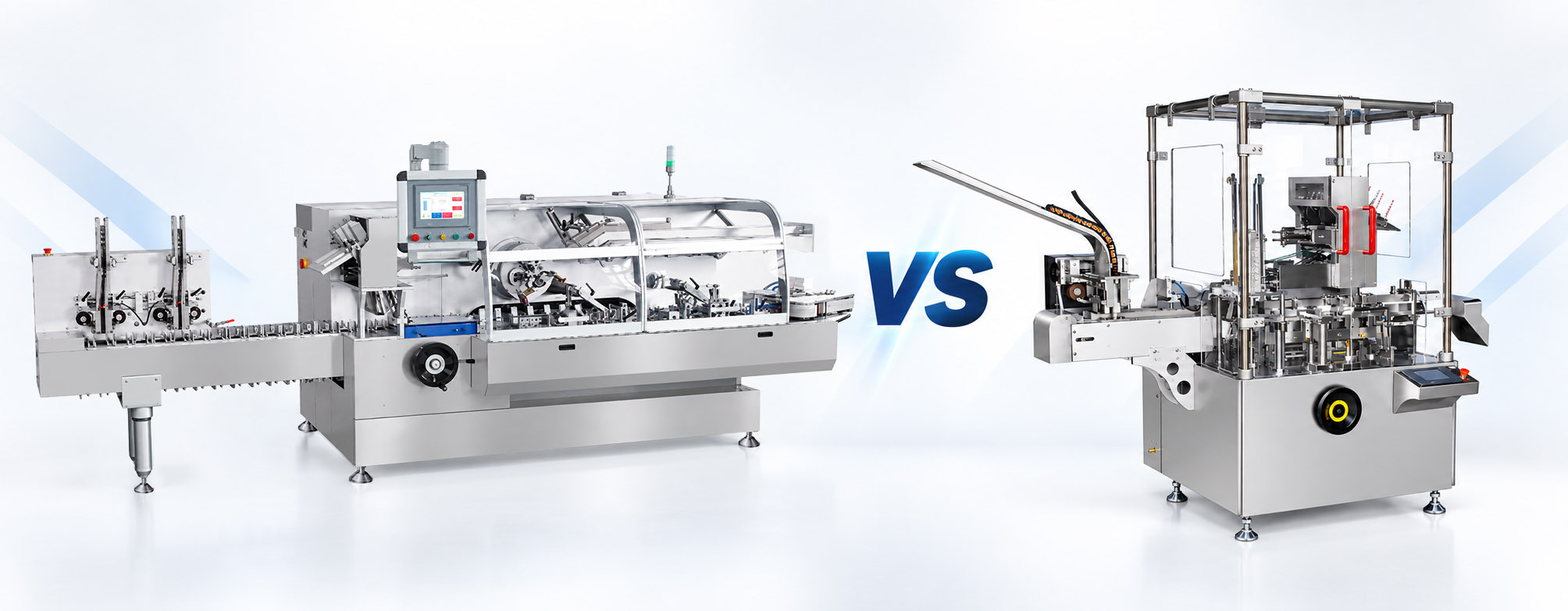
A horizontal cartoner is long and low — right for a wide room. A vertical cartoner takes less floor and goes up instead — right for a room that’s narrow but has height.
L-shaped and U-shaped layouts save floor but are easy to place across a walkway by accident. Mark your doors and your forklift routes on the drawing before anything else goes on it.
Compressed air matters more here than people expect — the machine picks and opens cartons with vacuum and ejects rejects with air, so supply pressure directly affects whether cartons open square.
Power: we build to your local supply — 60 Hz, 480 V or 208 V as needed.
Send us your floor dimensions — length, width, height, and where the doors and columns are — and we’ll lay out your line and check the space, free.
Four things go wrong on a cartoner. The machine treats them differently.
A machine that stops for everything costs you output. A machine that stops for nothing ships bad cartons. What matters is which it does, when.
| What happens | What the machine does | Why |
|---|---|---|
| Carton magazine running low | Light and sound alarm first, and it keeps running for a period so someone can refill it. If nobody does, it stops. | Protects your output and the machine at the same time |
| No product arriving | As standard, no alarm and no stop — the machine simply doesn't drop a carton. Alarm-and-stop is available if you'd rather have it. | A carton not dropped is a carton not wasted |
| Missing leaflet | Occasional: the finished carton is ejected by a reject cylinder. Continuous: treated as a leaflet feed fault — alarm and stop. | Separates a one-off from a real failure |
| Badly formed tuck | A photocell checks the closure before discharge and a bad carton is ejected. | Nothing leaves the machine unclosed |
| Jam or blocked insertion | Alarm, stop, and a fault code on the HMI. | Stops damage before it spreads |
| Mechanical overload | The overload clutch releases and the machine stops. | Protects the drive train |
None of that is unusual on a good cartoner. It’s on this page because most suppliers list the sensors and never tell you the logic — and the logic is what your line supervisor lives with every day.
Four ways cartoning projects go wrong
None of these appear on a spec sheet. All of them appear after the machine has landed.
On grouped or stick-pack product the front end can be the larger number. Decided late, it also arrives late — and the cartoner sits there waiting for it.
Tuck to glue isn’t a change. It’s a different machine.
It fitted because a person put it there. This gets discovered at commissioning, which is the most expensive possible moment to discover it.
The cartoner runs at the speed of whatever feeds it, and that is rarely the cartoner’s rating.
Three times we'd tell you not to buy one yet
Hand-packing is probably still cheaper for you and will stay that way for a while. If the budget is there and you want the consistency anyway, that’s a fair reason to buy — but it’s a different reason, and we’d rather you bought it knowing which one you’re acting on.
That’s a case packer, not a cartoner. We build those too — ask us for that instead and spend the difference somewhere it does something.
Not a reason to walk away — a reason to talk to us earlier than you were planning to. Send us the product and we’ll size the carton around it, before anyone quotes you a machine.
What happens after you sign, and after we leave
Three things decide whether a machine from six thousand miles away becomes a working line: whether it holds accuracy, whether you have the paperwork to run it, and whether somebody shows up to start it.
Carton forming, product insertion and closure are checked by the machine at the points listed above — by sensors, not by an operator’s judgement.
Operating and maintenance manual in English. Electrical schematics and pneumatic diagrams. Spare parts list with part numbers. Installation and commissioning report, signed on site.
Our own engineers travel to your plant and commission the machine with your carton and your product. We do that for every cartoner we ship.
We keep spare parts in stock at our factory in China. Parts typically reach you in 2–3 days, and no more than a week.
We build these machines for supplement, food, cosmetic and personal-care producers. The machine doesn’t change; what you have to satisfy does. Tell us which requirements you’re running under and we’ll match the documentation to them.
U.S. line: +1 (213) 526-8644. That reaches our engineers — not a distributor and not a call centre.
Send us the carton and the product. We'll send back numbers, not a brochure
With your carton dimensions, your product dimensions and a target output, we can tell you what the front end has to be, which machine class fits, how much floor it takes and what it costs to run.
Prefer to talk it through? +1 (213) 526-8644 — our engineers, not a distributor.
